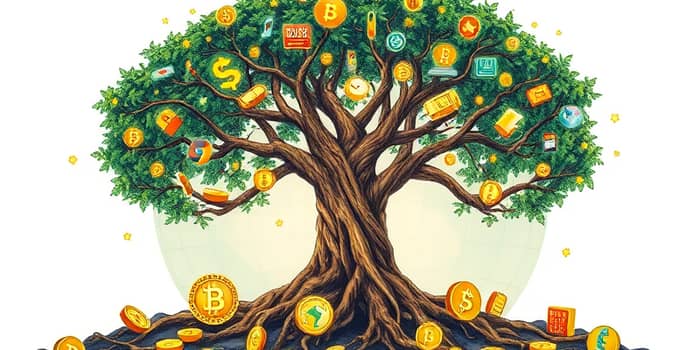
In an era defined by rapid change, the most successful economies and organizations are those that seamlessly convert capital into breakthrough ideas—and then channel those innovations back into sustained financial growth. Today, we explore how global leaders harness this cycle and how businesses can replicate their strategies.
Across the world, innovation drives capital formation, and capital fuels further innovation. Switzerland, ranking first in global innovation for its fifteen consecutive years at the summit, exemplifies how balanced investment in R&D, creative outputs, and supportive policy creates a virtuous cycle. The United States, consistently among the top three innovators, leverages market sophistication and startup funding to maintain momentum.
China’s ascent into the top 10 marks a pivotal shift. With the announcement of becoming the world’s largest R&D spender in 2024, the nation now claims second place in late-stage VC deals and business-financed R&D. This demonstrates that even economies with limited per-capita resources can achieve disproportionately strong innovation outputs when strategic priorities align.
Meanwhile, middle-income economies like India, Türkiye, and Viet Nam have climbed the innovation ladder by emphasizing high output efficiency relative to input investment. Their success underscores the principle that deliberate policy, focused at both national and regional levels, can unlock surges of ingenuity.
Emergent technologies are rewriting the rules of financial services. Over 42% of global banks have deployed AI-driven automation to reduce costs and accelerate customer service. At the same time, blockchain adoption has increased by 61%, not only streamlining settlements but also fortifying compliance and digital identity systems.
Banking-as-a-Service (BaaS) platforms now enable non-bank companies to launch regulated products via open APIs, while robo-advisors control assets exceeding $1.3 trillion. In the front office, AI chatbots handle 61% of customer queries, and predictive analytics tools have cut operational costs by 14%.
These innovations reflect a broader shift toward embedded finance and decentralized models, where companies integrate banking functions into everyday experiences. Neobanks, for instance, added 29 million accounts in 2025 alone, a testament to the demand for seamless, mobile-first solutions.
Global capital formation in finance is expanding at an impressive clip. The financial services market reached $29.7 trillion in 2025, growing at a 6.4% CAGR since 2022. Fintech valuations now exceed $335 billion, with annual funding up 15% to $141 billion.
This influx of capital nurtures the next generation of unicorns. Nigeria has emerged as an unexpected hotspot, combining high-value startups with microfinance innovations, while Southeast Asia’s exchanges of ICT services propel the Philippines and Viet Nam to the forefront of high-tech exports.
Innovation efficiency shines brightest where resources are scarce. In nations such as Nigeria, Ethiopia, and Senegal, targeted investments in microfinance and capital formation have unlocked remarkable growth. For example, Senegal’s microfinance sector has become a vital channel for small business financing, driving both inclusion and new venture creation.
Similarly, India’s ICT service exports and Viet Nam’s manufacturing modernization illustrate how focused strategies can turn local strengths into global competitive advantages. Governments in these regions have prioritized regulatory frameworks that promote fintech partnerships, resulting in rapid digital finance adoption and 23% growth in digital identity registrations.
The modern consumer expects more than generic offerings. A recent study found that 74% of customers demand personalized financial services tailored to their unique profiles. Institutions are responding with advanced CRM systems powered by AI and big data analytics to craft bespoke investment plans, credit products, and insurance packages.
Digital identity solutions now authenticate 74 million users worldwide, significantly reducing fraud and strengthening trust. As institutions integrate ESG metrics into everyday decision-making, clients increasingly seek portfolios aligned with their values, driving $1.8 trillion in ESG asset growth.
With innovation comes new vulnerabilities. The financial sector accounts for 21.6% of global data breaches, prompting regulators to enforce stricter cybersecurity mandates. At the same time, instant lending and buy-now-pay-later (BNPL) services face tightening oversight to protect consumers from overextension.
Green finance funding has climbed to $580 billion, reflecting a shift toward low-carbon strategies. As climate risk becomes integral to financial planning, both regulators and investors are prioritizing sustainable capital allocation to achieve long-term resilience.
To cultivate an internal culture of innovation, companies must balance in-house development with strategic partnerships. Recent data shows a 95% failure rate for internal AI pilots, contrasted with 67% success when partnering with specialized firms. This stark difference highlights the value of external expertise and collaborative models.
Organizations that embed innovation into every layer—from leadership to frontline employees—stand the best chance of converting creative ideas into profitable offerings. Transparency, continuous learning, and a willingness to pivot based on real-time insights are all hallmarks of these successful firms.
Cultivating capital is more than investing money; it is about nurturing the ecosystems, technologies, and human networks that drive lasting value. From Switzerland’s well-balanced R&D investments to China’s rapid scale-up in private financing, the lessons are clear: strategic alignment of resources, a relentless focus on customer needs, and a bold embrace of emerging technologies are the keys to financial success.
By adopting these principles, businesses and economies can transform capital into a fountain of innovation—one that sustains growth, inclusion, and resilience in the ever-evolving global marketplace.
References